

Jurisdictional Review of Custody Trends by Offender Characteristics
In this review, the key global trends related to custody populations over a twenty-year period (2000-2019) by age group, gender, ethnic background, and offence type1 will be identified. The research will focus on the trends in select Canadian provinces, Australia, New Zealand and the United Kingdom.
By Alexandra Zidenberg, Shannah Dutrisac, Davut Akca, and Lisa JewellUnderstanding the trends in custody populations at provincial, national, and global levels is key to developing decisive policies in the criminal justice system. In that sense, a review of trends in custody populations in Saskatchewan and other jurisdictions is needed to provide policy makers and decision makers with strategic insights into Saskatchewan’s custody population, including identification of underlying factors contributing to custody population growth and key intervention points. The University of Saskatchewan’s Centre for Forensic Behavioural Science and Justice Studies has been contracted by the Saskatchewan Ministry of Corrections, Policing and Public Safety to conduct a Jurisdictional Review of Custody Trends by Age, Gender, and Ethnicity.
Research Questions
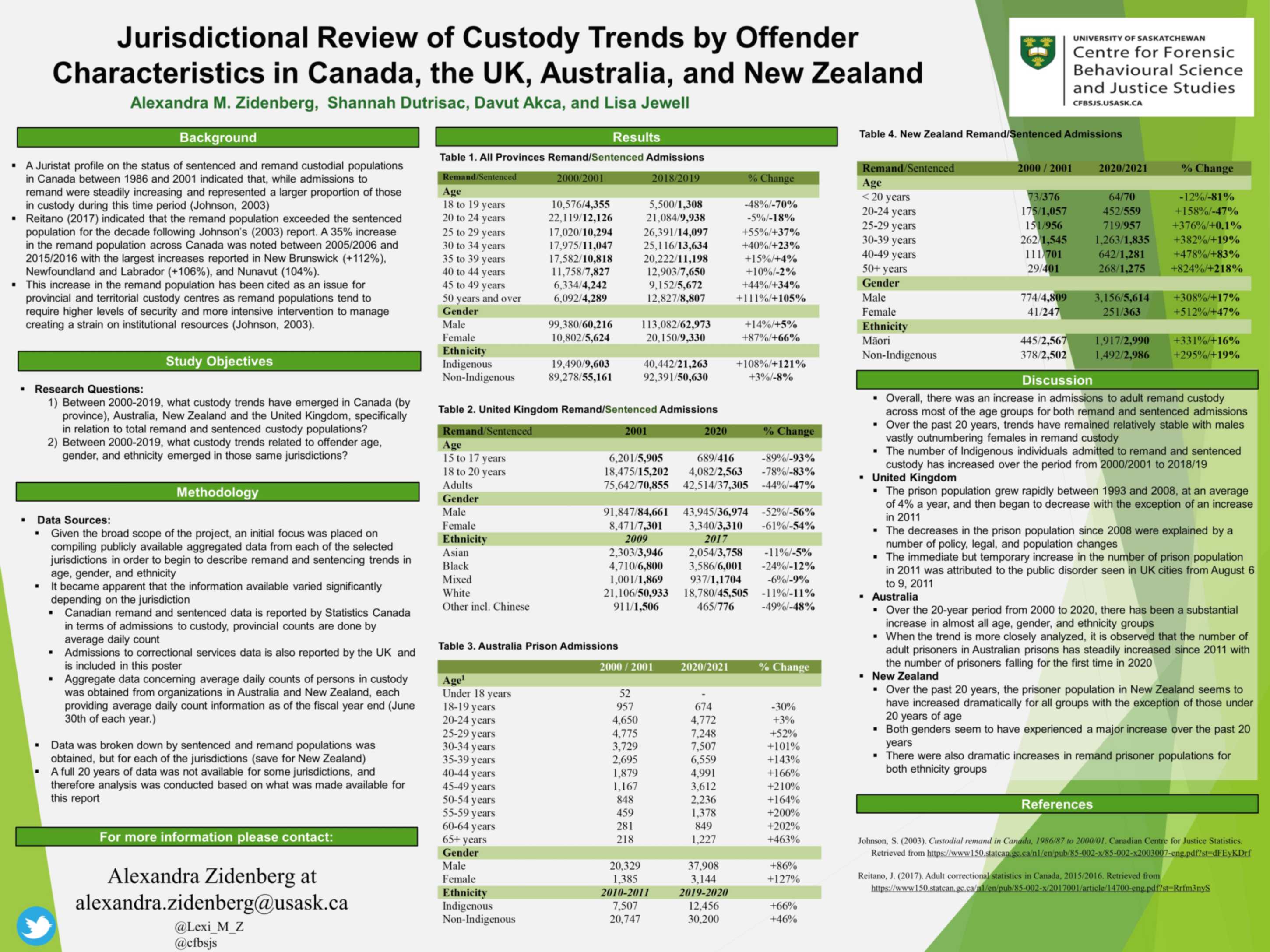
- Between 2000-2019, what custody trends have emerged in Canada (by province), Australia, New Zealand and the United Kingdom, specifically in relation to total remand and sentenced custody populations?
- Between 2000-2019, what custody trends related to offender age, gender, ethnicity, and offence type emerged in those same jurisdictions?
Key Trends
In summary, following key trends were observed across the jurisdictions included in this scan with respect to age, gender, and ethnicity:
- Across the majority of jurisdictions, there has been a shift in age demographics where those 18 to 24 years of age have experienced a decrease in both sentenced and remand admissions over the last 20 years and those 25 to 30 year of age have experienced an increase (with the exception of Manitoba remand and sentenced admissions, the 20-24 age group of sentenced admissions in Saskatchewan, and the 20-24 age group for sentenced admissions in New Zealand). Additionally, while still a relatively small proportion of the overall prison population, the 50+ age band has experienced a
significant increase in many jurisdictions over the past 20 years. A trend towards an older overall prison population brings unique considerations for their care (Kerodal et al., 2020). - In the majority of jurisdictions, there was an increase in female remand and sentenced admissions—and often a very large increase. However, there were a few exceptions to this trend. For remand admissions, Alberta, British Columbia, and the United Kingdom all experienced a decrease in female admissions. Ontario, Manitoba, and the United Kingdom all experienced decreases in sentenced admissions for females. While females were a much less populous group than males, the increase was still quite large and represents an increase in demand for resources specific to female incarcerated
individuals. - Indigenous remand and sentenced admissions increased for all jurisdictions with the exception of remand admissions in Saskatchewan. In fact, over the past 20 years, Indigenous admissions have been increasing for remand and sentenced in the majority of jurisdictions even when there has been a decrease in non-Indigenous admissions in the jurisdiction. This trend has important implications for the continued overrepresentation of Indigenous individuals in Canada’s incarcerated population.
- The United Kingdom seems to be an exception to many of these trends as all categories surveyed in the UK decreased over the past 20 years. These changes could be explained due to a decreasing population in the UK and unique legislation (the Criminal Justice and Immigration Act 2008; the Legal Aid, Sentencing and Punishment of Offenders [LASPO] Act 2012) that was introduced during this time period.
- The largest increases in Canada were noted for Manitoba in both the sentenced and remand categories. Additionally, exceptionally large increases were noted for remand admissions in New Zealand. These large increases merit further examination to determine the potential causes.